Published 2026-11-17
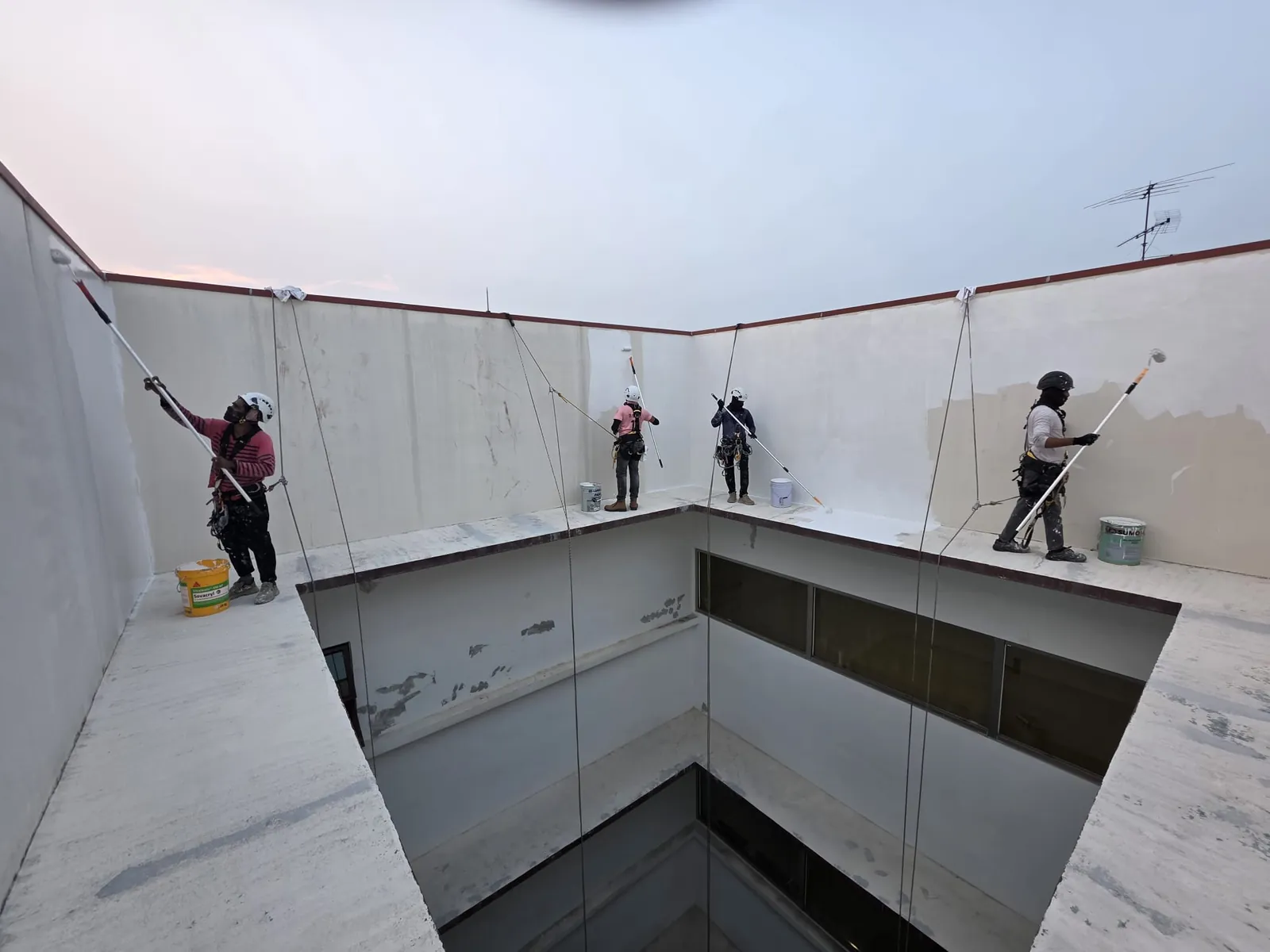
Photo above: Recessed walls set back from the roof edge.
Locate the work in three dimensions
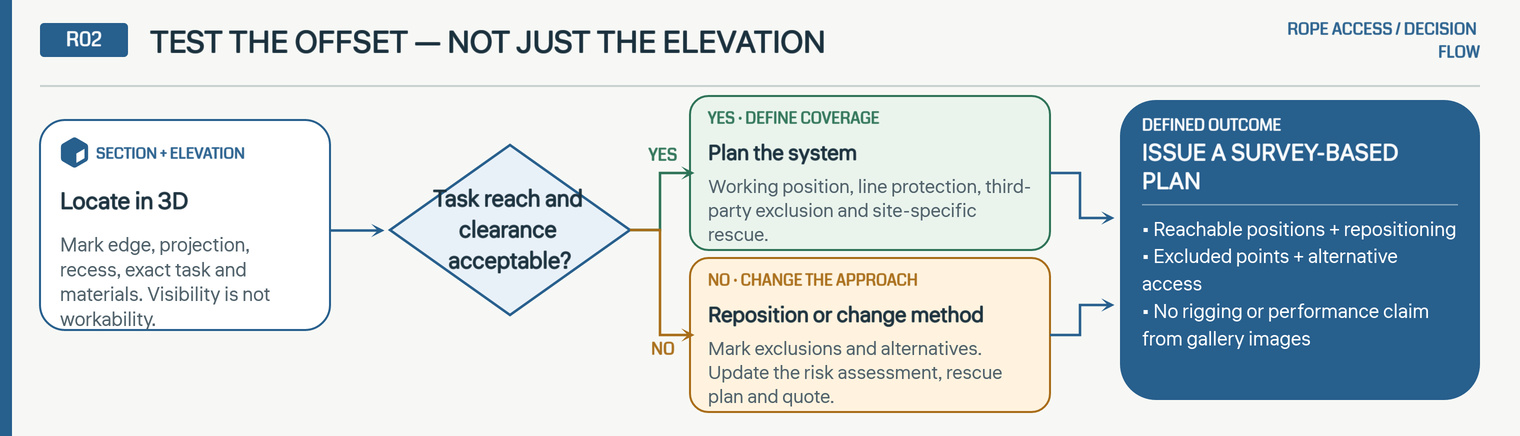
A recess, podium projection, return or underside may place the work away from the direct descent line. Use a section or side photograph as well as the front elevation. Mark the exact work area, the edge above it, the offset and any obstructions or surfaces that could affect anchor-line protection and movement.
Our project gallery includes horizontal rope-access work at Tampines. Every building is different, though: a past job does not establish the rigging design, dimensions or performance needed on yours. [1]
Brief the task, not only the coordinate
Explain whether the work is inspection, cleaning, sealant removal, coating or replacement involving tools and materials. A technician may be able to see a point but not perform the intended task safely from that position. Include the area below, entrance and traffic constraints, available anchorage information, clearance and any alternative access that could reach the zone.
The proposed system should address working position, pendulum and clearance exposure, anchor-line protection, third-party exclusion and site-specific rescue. IRATA provides guidance on these elements; Singapore’s regulations separately require PE-designed anchorages and anchorage lines for industrial rope access, subject to the stated exclusions, and start-of-shift system inspection by a competent person. [2] [3]
Record coverage and limitations after the survey
Ask for a survey plan showing reachable positions, areas requiring repositioning, excluded points and any alternative method. Link those decisions to the quotation and sequence. If the survey changes the assumed approach, update the risk assessment, rescue plan and scope rather than treating the original ‘drop count’ as fixed.
Related: see our facade repair and maintenance by rope access, and read Can Rope Access Reach the Underside of a Canopy? and What Is Rope Access Used For in Singapore Buildings?.
Practical checklist
- Provide elevation, section or side view and exact task location.
- State material handling and task requirements, not just visibility.
- Assess clearance, pendulum, line protection, anchorage and rescue.
- Mark inaccessible or alternative-method areas explicitly in the scope.
References
- Ezzogenics. (n.d.). Project gallery. https://rope-access-singapore.com/gallery/
- IRATA International. (2014). IRATA International code of practice for industrial rope access (TC-102ENG, 2014-Aug-01 v2; live document with amendments). https://irata.org/uploads/documents/International_Code_of_Practice_%28ICOP%29_-_English_TC-102ENG.pdf
- Workplace Safety and Health (Work at Heights) Regulations 2013 (Singapore), regs. 29–30. Singapore Statutes Online. https://sso.agc.gov.sg/SL/wsha2006-s223-2013